
Business valuation
Know what your business is worth today
A business is worth a multiple of its normalized earnings, set by the risk a buyer sees in them, then adjusted for net debt and working capital. The multiple moves with growth, recurring revenue, customer concentration, and how much of the business depends on you.
How it works
How do you calculate what a business is worth?
A private company is valued in four steps: normalize the earnings, find the range of multiples buyers pay for businesses like yours, place the business in that range by its risk, then adjust for net debt and working capital. A figure you have not tested is a hope, not a plan, and these are the steps a buyer will use to test yours.
Step 1
Normalize the earnings
Restate the profit the way a buyer will see it: one-off costs taken out, personal expenses added back, the owner's pay added back or set at a market salary, depending on the measure of earnings, and every adjustment documented.
Done when every adjustment has a document behind it, and you know which measure of earnings, seller's discretionary earnings (SDE) or EBITDA, a buyer of a business your size will use.
Step 2
Find the range buyers pay
Every industry trades within a band of multiples, and the band moves with size and with the likely buyer: a strategic acquirer, a private equity fund, and an individual buyer price the same business differently. Published surveys give a starting point, as long as their multiples are on the same measure as your earnings.
Done when you have a range for your industry and your size, on the same measure of earnings as yours.
Step 3
Place the business in the range
The multiple is a judgment on risk: growth, recurring revenue, customer concentration, and how much of the business depends on you. Two businesses with the same profit can sell at very different multiples, and this is the step owners are least neutral about.
Done when you can name the evidence that puts the business where it sits in the range, and what would move it.
Step 4
Adjust for net debt and working capital
Enterprise value is not what you take home. Net debt comes off, and the working capital the business needs to run is left behind at close. The adjustments are agreed with the buyer, not assumed.
Done when you know the business's net debt and the working capital it needs, and what the headline leaves after them, before fees, structure, and tax.
Steps 2 and 3, finding the range and placing the business in it, are judgments, not arithmetic. That is why two valuations of one business rarely agree.
Ways to get one
How do you get a business valuation?
There are five routes to valuing a privately held business, each for a different decision: an online calculator, a broker's opinion of value, an accountant's report, a formal appraisal, and an advisory platform. Pick the method that matches the decision in front of you, and know what it cannot tell you.
| Route | For | Time | Where it falls short |
|---|---|---|---|
| An online calculator | A first sense of scale | Minutes | It applies an average multiple to the figure you type in. It cannot see the risk in your business, so it cannot tell you why the number is what it is. |
| A broker's opinion of value | What the market might bear today | Days to a couple of weeks | It reads recent sales of similar businesses. It is a view on price, not a plan to change it. |
| An accountant's report | Earnings you can rely on | Weeks | Strong on the numbers and the adjustments, lighter on what a buyer will pay for them. |
| A formal appraisal | Tax, estate, lending, or a dispute | Weeks, with a fee to match | Built to a standard a court or the IRS will accept. Rigorous, but a fair market value is not the price a motivated buyer pays. |
| An advisory platform | A number you can work on | Ten minutes to start, then ongoing | The FNDRS valuation reads the elements behind the figure, scored today and at target, so the number comes with the work that moves it. It is not a substitute for a formal appraisal where one is required. |
What to gather
What do you need for a business valuation?
Three years of numbers, the adjustments to them, and the facts a buyer prices as risk: eight items cover a first valuation, whichever route you take. Your CPA holds most of the financial items, and your attorney the contracts.
Why it matters: Normalized earnings start from them, and a buyer will rebuild the same years.
Why it matters: An add-back is an argument, and only the ones with proof survive a buyer's review.
If it is missing: Write down the reason for each one now, while the records are easy to find.
Why it matters: The difference is often the largest adjustment in a founder-led business.
Why it matters: Customer concentration is one of the first risks a buyer prices.
Why it matters: Revenue a buyer can count on raises the multiple it pays.
Why it matters: They are the difference between enterprise value and what changes hands at close.
Why it matters: Owner dependence is priced in the multiple, and some owner-dependent businesses do not sell at all.
If it is missing: Name the decisions that only you make today, and who could make each one.
Why it matters: What cannot transfer with the business is risk a buyer discounts.
SDE or EBITDA
Is a business valued on SDE or EBITDA?
Smaller businesses are usually valued on seller's discretionary earnings (SDE) and larger ones on EBITDA: the IBBA and M&A Source Market Pulse Survey reports deals under $2 million as multiples of SDE, and deals of $2 million to $50 million as multiples of EBITDA.
Seller's discretionary earnings (SDE)
The profit one owner-operator takes out of the business: earnings before interest, taxes, depreciation, and amortization, with the owner's own pay and benefits added back. A buyer who will run the business reads it as what the business pays its owner.
EBITDA, adjusted
Earnings before interest, taxes, depreciation, and amortization, with a market salary for the owner's role kept in, because the buyer will pay someone to do the job. A buyer who will not run the business itself reads it.
The two are not interchangeable, and neither are their multiples. SDE is the larger number for the same business, so a multiple of SDE runs lower than a multiple of EBITDA: apply a figure quoted on one to earnings measured on the other, and the answer is wrong before the work starts.
In the same survey, for the second quarter of 2026, the multiple reported for businesses of $1 million to $2 million in enterprise value was 3.1 times SDE, and for those of $2 million to $5 million, 4 times EBITDA: two figures on two measures, which say little about each other. The survey's figures come from 255 business brokers and M&A advisors reporting on 181 deals they closed in the quarter, as the advisors reported them, not audited deal data.
Adjusted EBITDA, definedDependence
What does owner dependence do to the price?
It lowers it: buyers price the risk that the earnings leave with you, with a lower multiple, a longer earn-out, or both, and some owner-dependent businesses do not sell at all. Two businesses with the same earnings, one that runs without its owner and one that does not, are priced very differently, and a buyer works out which one you are with three questions.
- Who holds the customer relationships?
- Who makes the decisions when you are not there?
- What stops working if you take a month off?
companies FNDRS assessed for scalability list dependence on the founder among their constraints.
Inside the platform
From the first conversation to a number you can work on
The FNDRS valuation is built in four steps on the platform. Step through them to see what each one does.
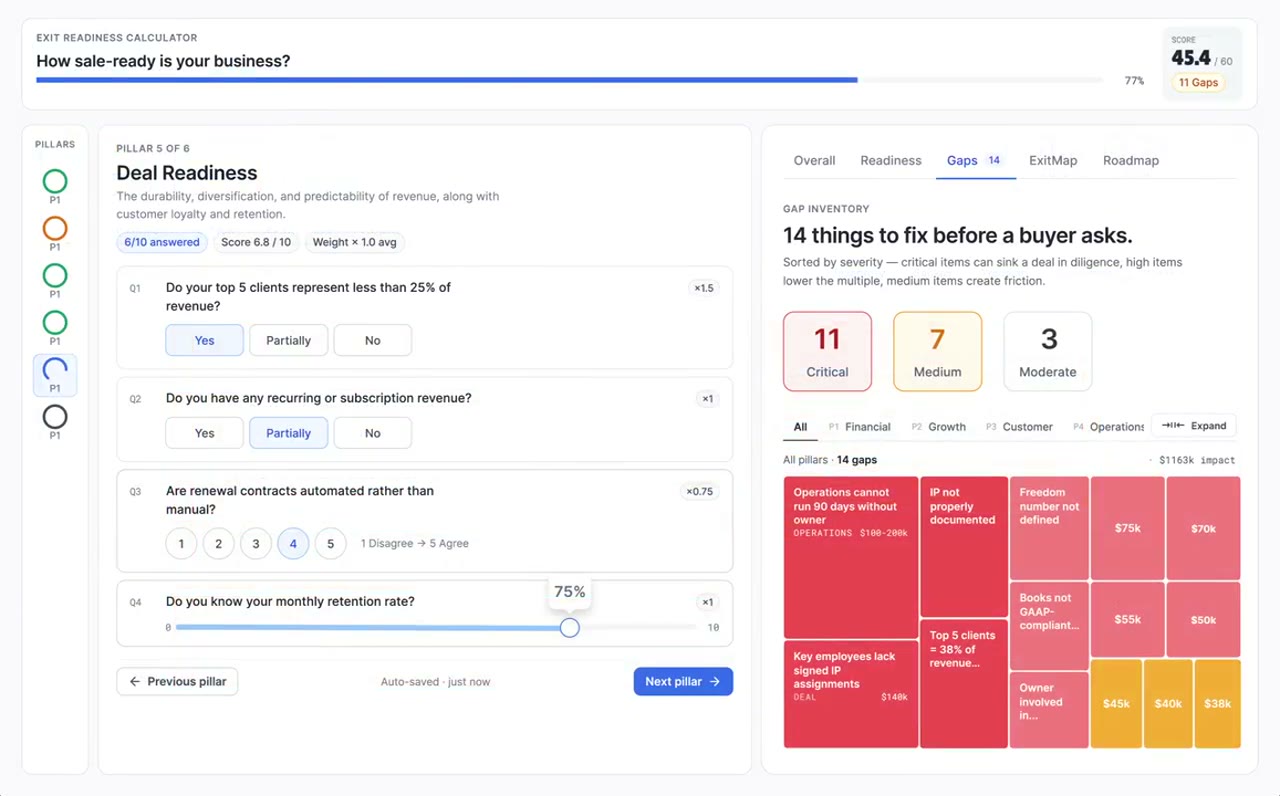
01 / 04 · Discovery
Gap calculator
Meet with a FNDRS specialist to find the gaps in your business and the value they are costing you, in the hundreds of thousands or the millions.
FNDRS Elements™
The elements that set the multiple
Buyers do not pay for revenue. They pay for earnings they believe will survive the handover. These are the elements that decide which way that judgment goes, scored today and at target.
- Rr09 · Recurring RevenueRevenue that repeats under contract or habit without being re-sold each period.
- Od19 · Owner DependenceHow much of revenue, relationships, and decisions route through the owner. Scored as control: higher is safer.
- Cf11 · Clean FinancialsAccrual books, reconciled monthly, that survive a quality-of-earnings review.
- Cc21 · Customer ConcentrationRevenue share held by the top customers. Scored as control: higher is safer.
The six pillars
The six report cards a buyer reads
Every buyer, lender, and diligence team reads a company on the same six things. The 36 elements of the FNDRS Elements framework roll up into them, and the exit-readiness score gives each one a mark from zero to one hundred.
 1:49
Whiteboard session
Nick on enterprise value
Nick works through this element as in an FNDRS workshop: what a buyer is really asking, how the score moves, and the first thing to fix.
Nick LongCEO and co-founder

Scoring
Scored today, and scored at target
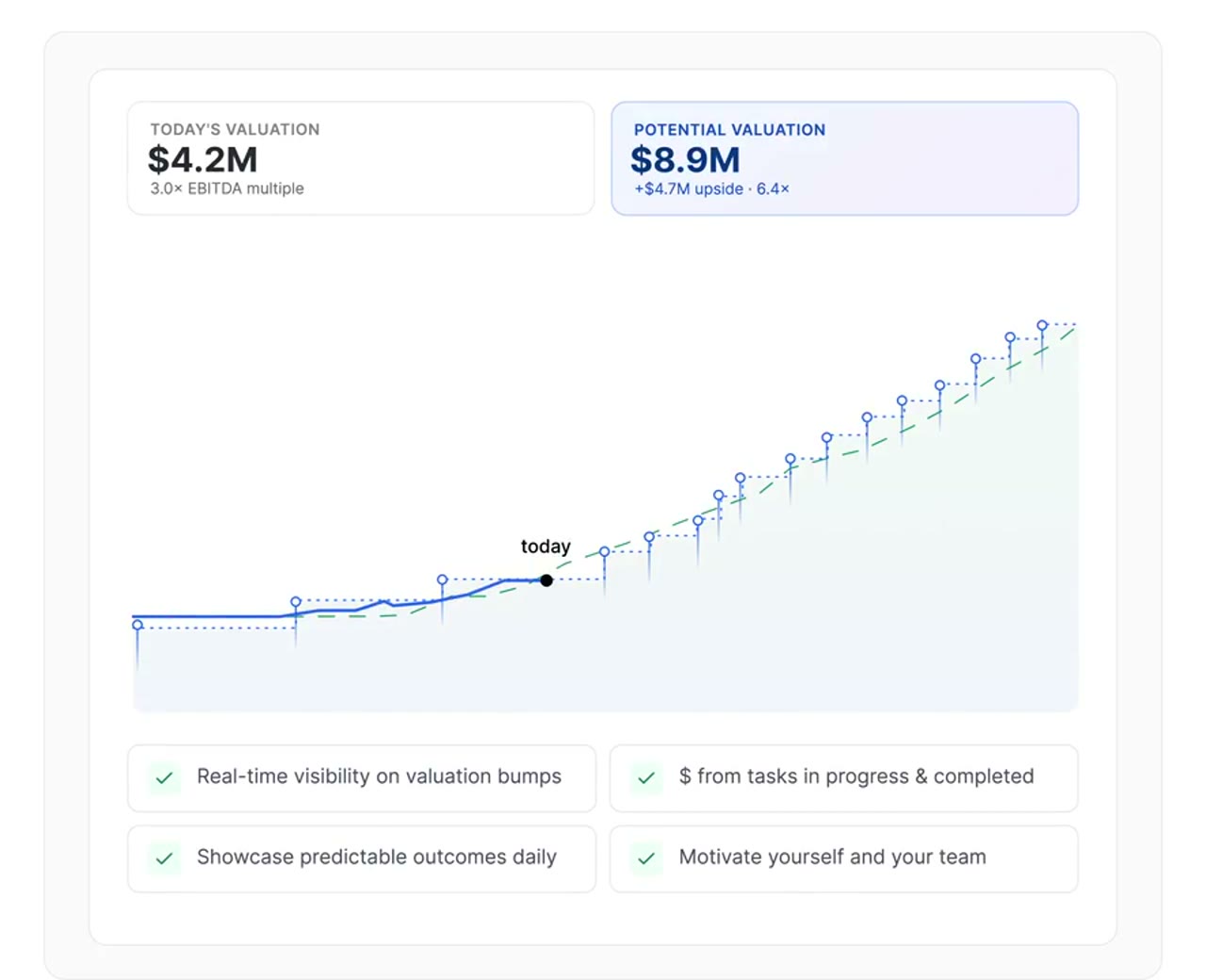
A FNDRS valuation is not a figure on a page. Every element carries a score today and a score at target, and the gap between the two is the work. The number is the output; the scores are the instructions.
- Where each element stands now
- Where it needs to be before a buyer looks
- The tasks that close the gap, in order
Questions
What owners ask about a valuation
A multiple of its normalized earnings, set by the risk a buyer sees in them. Net debt and working capital adjust that figure before anything changes hands, and smaller businesses are usually priced on seller's discretionary earnings (SDE), larger ones on EBITDA. For scale, in the IBBA and M&A Source Market Pulse Survey for the second quarter of 2026, the multiple reported for businesses with an enterprise value of $5 million to $50 million was 5.8 times EBITDA, from 255 business brokers and M&A advisors reporting on 181 deals they closed in the quarter. Where yours lands depends on growth, recurring revenue, customer concentration, and how much of the business depends on you; the exit score shows where it sits today.
From nothing to tens of thousands of dollars. An online calculator is free. A broker's opinion of value is often free when it leads to a listing. A formal appraisal for tax or litigation carries a professional fee that grows with the size and complexity of the business.
Minutes for an online calculator, days to a couple of weeks for a broker's opinion, and several weeks for a formal appraisal. Most of the time goes into gathering and normalizing the financials.
You can estimate it: normalize the earnings, find a fair range of multiples for your industry and size, and adjust for net debt. The hard part is the multiple, because it is a judgment on risk, and owners are rarely neutral about their own risk. An outside view earns its keep there.
A valuation is an estimate of what the business is worth. An offer is what one buyer will pay, on their terms: how much is cash at close, how much is deferred or tied to performance, and what you have to leave behind. Two offers at the same headline price can be worth very different amounts.
At least once a year, and after anything that changes the business: a large customer won or lost, a key hire, a new recurring revenue line. A number that is a year old describes a business that no longer exists.
A formal appraisal, done to a recognized standard by a credentialed appraiser. Lenders, estate filings, gifting, and disputes need a figure that will stand up to review. An advisory valuation answers a different question: what a buyer will pay, and what you can change before one looks.
Next step
Two ways to get your number
One takes fifteen minutes and costs nothing. The other is a conversation with the people who run the sale. Start with whichever matches how close you are.
A number is only useful if you can move it
Find out what the business is worth today, what it could be worth, and the elements that close the gap.