
Financial health
Financial health is the pillar a buyer's accountant reads first: accrual books closed within fifteen days of month end, gross margin stable or rising as revenue grows, and add-backs a quality-of-earnings review will accept. It sets the ceiling on every other pillar.
The film
What a buyer's accountant reads first
The four elements behind books a buyer trusts: Clean Financials, Gross Margin, Overhead Efficiency, and Predictability. What the gaps look like in a $3M to $30M business, and where to start.
What buyers measure
- Accrual financials, reconciled monthly, with a clean audit trail
- Normalized earnings: add-backs a quality-of-earnings review will accept
- Gross margin and overhead trends over three years, explained
- A forecast the last three years make believable
What good looks like
- Books closed within fifteen days of month end
- Gross margin stable or rising while revenue grows
- Owner compensation and personal expenses separated from the business
- One set of numbers: the tax return, the management accounts, and the pitch agree
Where owners fall short
- Cash-basis books that hide timing and margin
- Add-backs no reviewer will accept
- Margins only the owner can explain
- A forecast built on hope rather than pipeline
The numbers that move it
How is financial health measured?
Financial health moves with four numbers: gross margin, EBITDA margin, days to close the books, and forecast accuracy.
Gross margin
Trend over three years
EBITDA margin
Normalized
Days to close the books
Target: fifteen
Forecast accuracy
Last four quarters
The elements behind it
Which elements make up financial health?
Financial health is scored from four of the 36 elements in the FNDRS Elements™ framework: clean financials, gross margin, overhead efficiency, and predictability. Each opens its own entry.
All 36 elements- Cf11 · Clean FinancialsAccrual books, reconciled monthly, that survive a quality-of-earnings review.
- Gm06 · Gross MarginRevenue left after direct costs; the ceiling on everything below it.
- Oe08 · Overhead EfficiencyFixed costs held flat as revenue scales.
- Pd12 · PredictabilityForecasts that come true; a pipeline a buyer can underwrite.
 6 min
Whiteboard session
Ashley on predictability
Ashley works through this element as in an FNDRS workshop: what a buyer is really asking, how the score moves, and the first thing to fix.
Ashley SmithCOO

How FNDRS moves it
Advised, tracked, and re-scored
A fractional CFO read of the books in the analysis stage, then a monthly close cadence with your advisor until the numbers hold on their own.
- In the processValuation and analysis in the FNDRS process
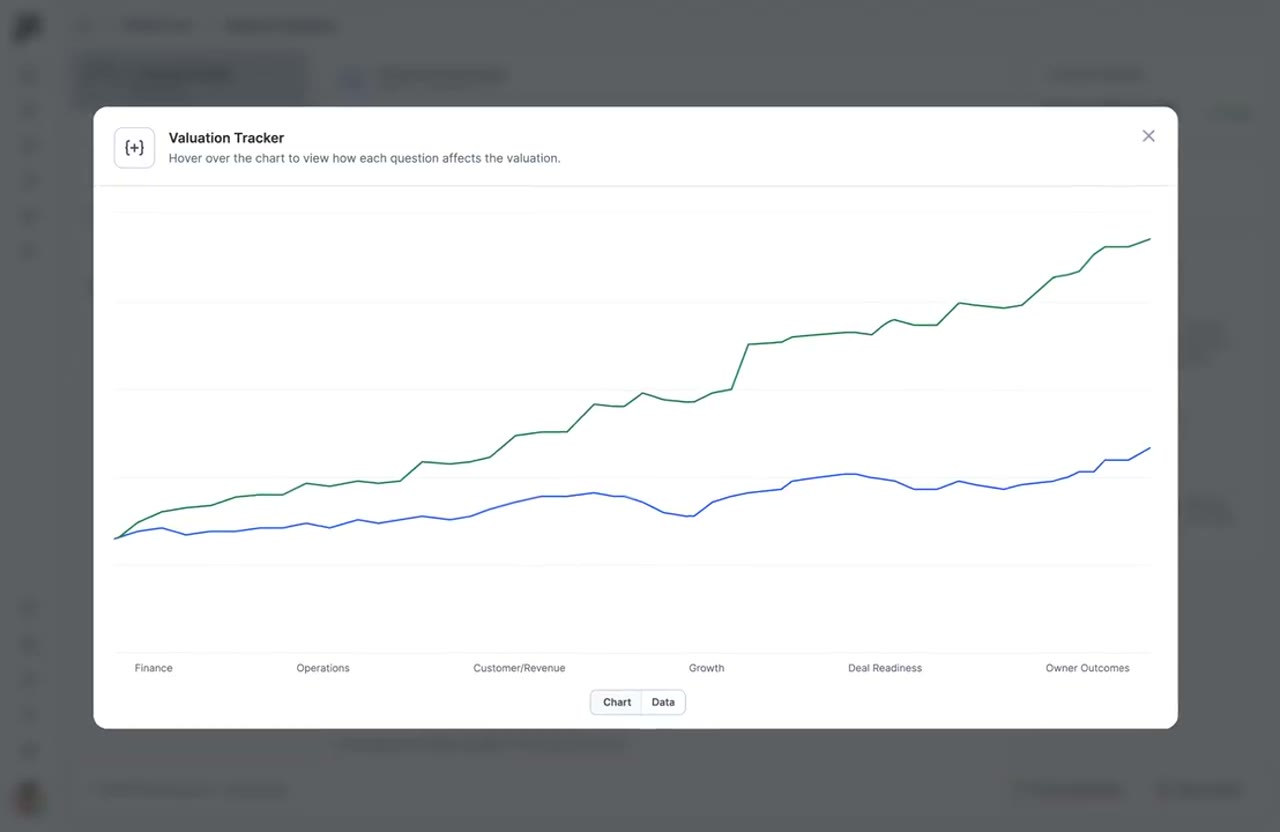
- In the platformValuation tracker
- ToolsGet your exit score
Questions
Owners ask
Rarely for a founder-led company. You need accrual books that reconcile and a quality-of-earnings review you can pass. That is a matter of discipline, not an audit fee.
Owner compensation above market, one-time costs, and personal expenses run through the business, each with documentation. Recurring costs dressed up as one-time are the fastest way to lose a buyer's trust.
Where do you stand on financial health?
The exit-readiness score gives this pillar a mark from zero to one hundred and the three gaps worth closing first.